








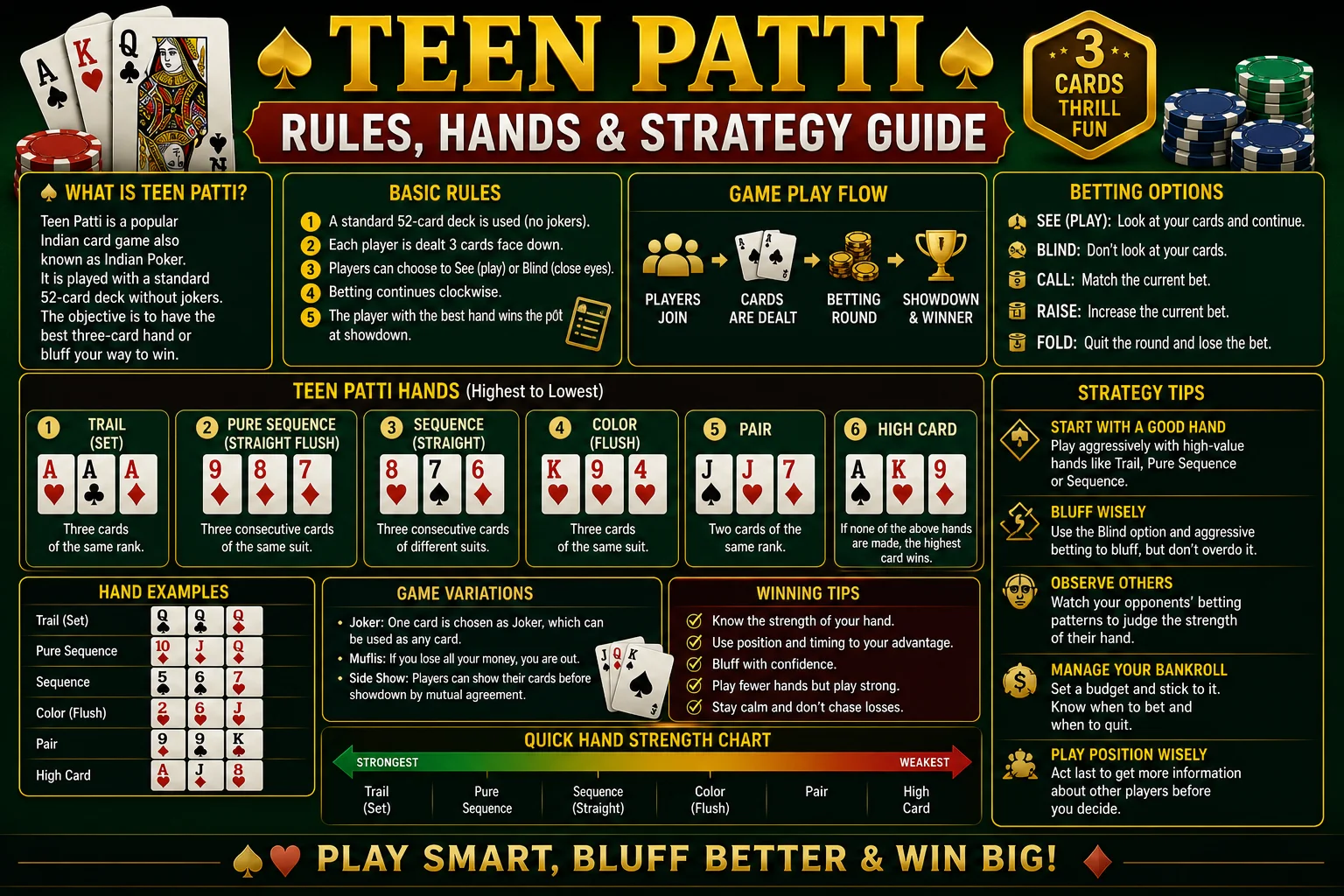
Teen Patti Rules Hands Strategy Guide
 Teen Patti Rules Strategy Hand Rankings Full Guide
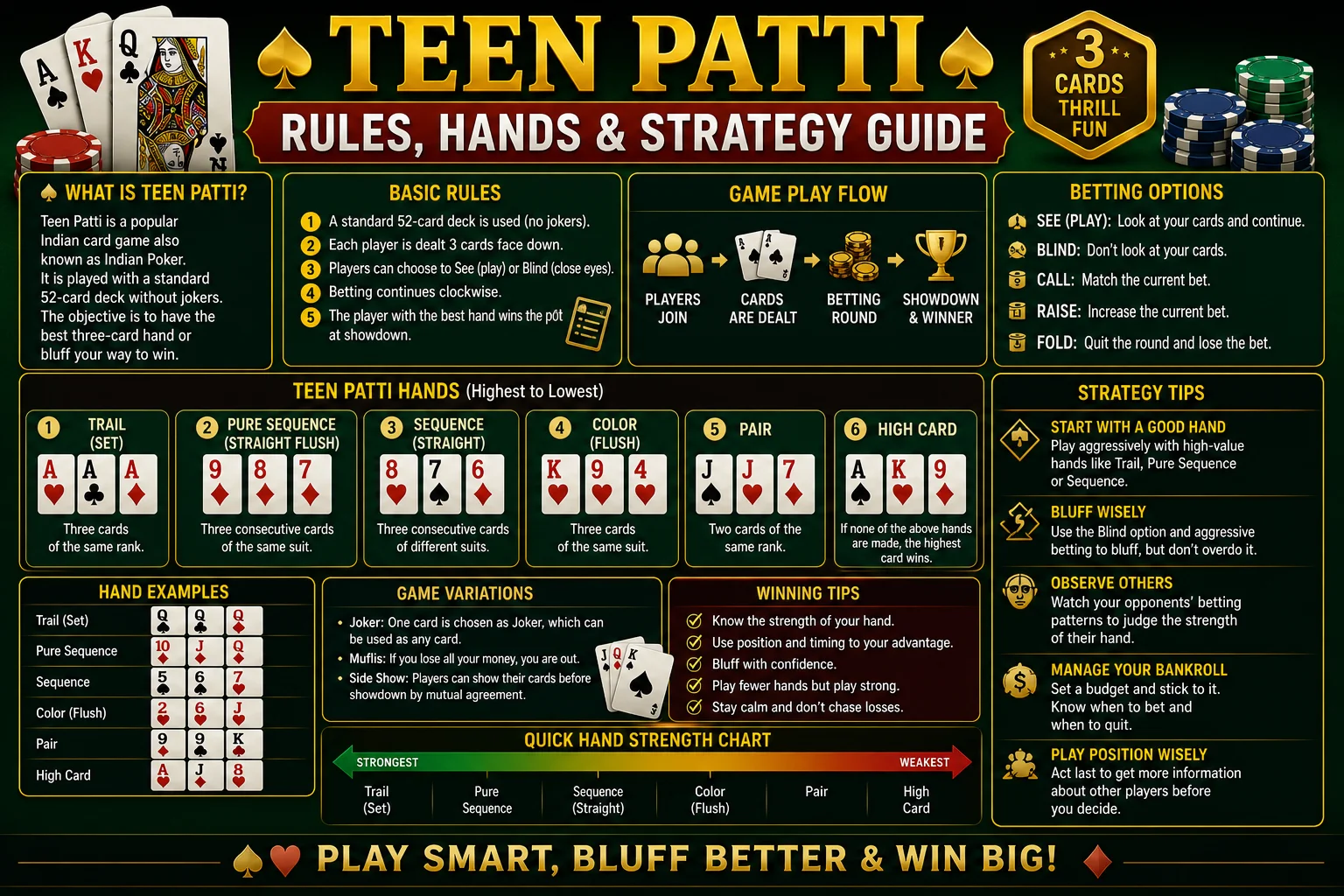 Teen Patti Rules Strategy Hand Rankings Full Guide
Teen Patti is a three-card Indian card game where players bet on who holds the strongest hand. Hands rank from Trail (three of a kind) at the top down to High Card at the bottom. The last player remaining after all others fold wins the pot.
Teen Patti is one of the most popular card games in South Asia—played at family gatherings, festivals, and increasingly on mobile apps for real cash. Originating in India and drawing loose inspiration from British three-card brag, the game has evolved into a digital phenomenon with millions of active players across India, Bangladesh, Pakistan, and Nepal. reddy anna guru login
Whether you’re picking up cards for the first time or looking to sharpen a strategy that actually wins, this guide covers everything: the official rules, hand rankings, sequence list, top apps, proven strategies, popular variations, and a clear breakdown of how Teen Patti compares to poker.
What Are the Official Teen Patti Rules
Teen Patti is played with a standard 52-card deck (no jokers) and supports 3 to 6 players. Each player places a mandatory boot amount—the minimum stake into the pot before cards are dealt.
How a round works
The dealer distributes three face-down cards to each player.
Players choose to play blind (without seeing their cards) or seen (after viewing them).
Betting continues clockwise. Blind players bet the current stake; seen players bet double.
Players can call, raise, or fold each turn.
The game ends when all but one player folds, or two players reach a showdown.
The player with the highest-ranking hand wins the pot.
A sideshow (compromise) can be requested between two seen players to compare hands privately—the weaker hand must fold.
Teen Patti Hand Rankings Best to Worst
Understanding hand rankings is non-negotiable. Here’s the complete Teen Patti sequence list from strongest to weakest:
1. Trail Three of a Kind
Three cards of the same rank. Three Aces is the highest trail; three 2s is the lowest.
Example: A♠ A♥ A♦
2. Pure Sequence Straight Flush
Three consecutive cards of the same suit.
Example: 7♣ 8♣ 9♣
3. Sequence Straight Run
Three consecutive cards, not all the same suit.
Example: 4♠ 5♦ 6♥
4. Color Flush
Three cards of the same suit, not in sequence.
Example: K♠ 9♠ 4♠
5. Pair (Two of a Kind)
Two cards of the same rank. Higher pair wins; if equal, the third card (kicker) decides.
Example: J♣ J♥ 6♦
6. High Card
No combination. The hand with the highest individual card wins.
Example: A♦ 9♣ 3♠
Teen Patti Variations You Should Know
The base game spawned dozens of regional and online variations that change how hands form or how cards are dealt:
Muflis (Lowball): Hand rankings are completely reversed. The weakest hand in standard play becomes the strongest.
AK47: Cards A, K, 4, and 7 act as wild cards (jokers).
Joker Hunt: Players must collect joker cards during the round to strengthen their hand.
999: The hand closest to 999 (using card face values) wins.
Best of Four: Each player receives four cards and must form the best three-card hand.
Stud Teen Patti: Some cards are dealt face-up, introducing a poker-like information layer.
Community: Shared community cards are placed on the table that all players can use.
Each variation demands a slightly different strategy, so understanding the rules of the specific variant before betting is critical.
Teen Patti Strategy How to Win More Often
Teen Patti involves both probability and psychology. Luck determines the cards; skill determines how you play them.
How to manage blind vs seen play effectively
Playing blind keeps your bet at half the stake of a seen player, which creates pressure on others without revealing anything about your hand strength. Experienced players often stay blind for several rounds—even with decent cards to build pot pressure cheaply.
Playing seen gives you decision-making clarity but doubles your minimum bet. Switch to seen when the pot is large enough to justify it or when you need precise information to decide whether to fold.
How to read betting patterns in Teen Patti
Aggressive raising from a typically passive player often signals a strong hand. Conversely, players who bet consistently at the minimum may be playing blind or holding a marginal hand. Watch for:
Sudden large raises: Usually indicates a Trail or Pure Sequence.
Consistent minimum bets: Often a blind player running a patience strategy.
Quick folds: Players who fold fast after a raise are likely holding High Card or weak Pairs.
How to calculate pot odds in Teen Patti
Before calling a bet, compare what you’d need to invest against what’s already in the pot. If the pot holds ₹200 and a call costs ₹20, you’re getting 10:1 odds. A weak pair might not justify a call at 2:1, but it becomes reasonable at 8:1 or better.
Teen Patti Tips Tricks for Beginners and Intermediates
Start with lower stakes. Build pattern recognition before moving to high-stakes tables.
Don’t overcommit to mediocre hands. A pair of 5s rarely justifies chasing a large pot against multiple seen players.
Use the sideshow wisely. Requesting a sideshow when you hold a strong hand forces weaker seen players out.
Control your table image. Alternate between aggressive and passive play to stay unpredictable.
Set a session limit. Decide your maximum loss before sitting down. Chasing losses is the fastest way to empty a bankroll.
Study variations before playing them for cash. Each Teen Patti variant has different hand values entering blind (no pun intended) is costly.
Teen Patti vs Poker Key Differences
Feature | Teen Patti | Poker (Texas Hold’em) |
Cards per player | 3 | 2 (+ 5 community cards) |
Deck | 52 cards | 52 cards |
Best hand | Trail (Three of a Kind) | Royal Flush |
Community cards | No (standard) | Yes |
Blind play option | Yes | No |
Skill ceiling | Medium | High |
Session length | Short | Long |
Origin | India | USA/Europe |
Choose Teen Patti if you want fast-paced, social gameplay with shorter sessions. Choose Poker if you prefer deep strategy, multi-street decision-making, and access to global competitive play.
Best Teen Patti Apps for Real Cash in 2024
Several platforms offer real-money Teen Patti games with licensed operations and secure payment gateways:
Teen Patti Gold – India’s most downloaded Teen Patti app with multiple table options and chip-based play.
Teen Patti Stars – Offers a wide range of variants and daily tournaments.
Teen Patti Master – Popular for real cash games and fast withdrawals via UPI.
MPL (Mobile Premier League) – Licensed platform with Teen Patti alongside other skill games.
A23 Games – RNG-certified platform offering both practice and cash tables.
Note: Real-money gaming laws vary by Indian state. Verify your local regulations before depositing funds. States including Andhra Pradesh, Telangana, and Nagaland have specific restrictions on online skill gaming.
Teen Patti Real Cash Guide What You Need to Know Before Playing
Playing Teen Patti for real money requires more than game knowledge requires financial discipline.
Before you deposit
Confirm the app holds a valid gaming license.
Check withdrawal timelines and minimum thresholds.
Read the KYC requirements (most platforms require Aadhaar or PAN verification).
Managing your bankroll
Never use more than 5% of your session bankroll on a single hand.
Withdraw winnings regularly rather than reinvesting everything.
Track wins and losses across sessions to understand your true performance.
Red flags to avoid
Apps without SSL encryption or clear licensing information.
Platforms that delay withdrawals beyond 72 hours without explanation.
Bonuses with unrealistic wagering requirements (e.g., 50x rollover).
The Bottom Line on Teen Patti
Teen Patti rewards players who understand hand rankings, manage their bankroll carefully, and adapt their strategy to the table. The game’s social DNA—designed for groups, quick sessions, and high energy—makes it uniquely engaging compared to longer-form card games.
Start with free-play tables to build confidence with the sequence list and betting mechanics. Once patterns become instinctive, the step up to low-stakes cash games is a natural progression. Whatever variant you play, the fundamentals remain the same: patience, observation, and disciplined bankroll management outperform reckless aggression every time.
Frequently Asked Questions About Teen Patti
1. What is the highest hand in Teen Patti?
The highest hand in Teen Patti is a Trail (three of a kind). Three Aces is the absolute best hand possible.
2. Can Teen Patti be played with 2 players?
Technically yes, but the standard game requires a minimum of 3 players. Two-player Teen Patti lacks the social dynamics and bluffing depth that make the game compelling.
3. What does “boot amount” mean in Teen Patti?
The boot is the mandatory minimum bet every player places into the pot before cards are dealt. It ensures every hand has value worth competing for.
4. Is Teen Patti legal for real money in India?
Teen Patti is classified as a game of skill in most Indian states, making real-money play legal. However, Andhra Pradesh, Telangana, and Nagaland have state-specific restrictions. Always verify local law before playing for cash.
5. What is the difference between a Pure Sequence and a Sequence in Teen Patti?
A Pure Sequence (Straight Flush) consists of three consecutive cards all of the same suit. A Sequence (Straight) is three consecutive cards from mixed suits. The Pure Sequence ranks higher.
6. How does the sideshow (compromise) work in Teen Patti?
A seen player can request a sideshow with the previous seen player. Both compare cards privately. The player with the lower-ranking hand must fold. The player who was asked can refuse the sideshow.
7. Which Teen Patti variation is best for beginners?
Standard Teen Patti is the best starting point. Once hand rankings and betting mechanics
Comments are closed